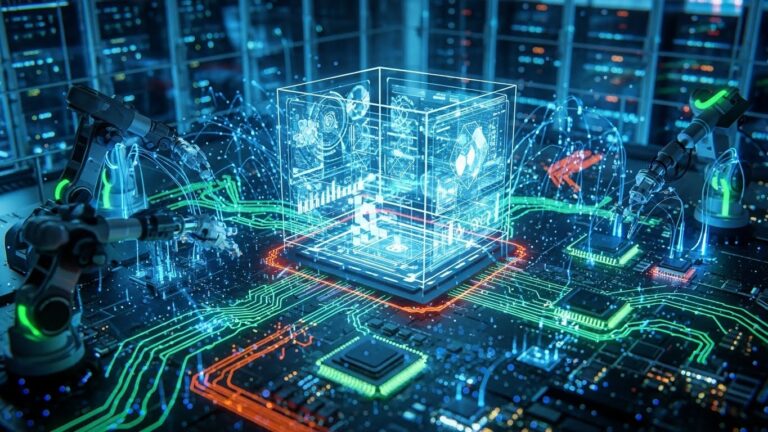

In an era where innovation evolves at an unprecedented pace, the tech landscape is constantly being reshaped. From artificial intelligence to quantum computing, the emerging technologies that are transforming our world hold the potential to redefine industries, economies, and daily life. These advancements not only promise to solve problems that once seemed insurmountable but also challenge our understanding of what is possible. In this blog, we will explore the most impactful emerging technologies and their far-reaching implications for the future.
1. The Rise of Artificial Intelligence (AI)
Artificial Intelligence (AI) has made remarkable strides in recent years, and its evolution is set to redefine every aspect of human life. Today, AI is no longer limited to science fiction but has become an integral part of our daily lives. From virtual assistants like Siri and Alexa to sophisticated algorithms used in healthcare diagnostics and autonomous vehicles, AI is transforming industries across the board.
AI’s capabilities have expanded to machine learning (ML) and deep learning, enabling systems to learn from data and improve their performance without human intervention. This has unlocked enormous potential in areas such as personalized medicine, predictive analytics, and even art creation. However, the rapid growth of AI also brings up questions regarding privacy, ethics, and job displacement, which need to be addressed as we move forward.
In the future, we can expect AI to become even more ubiquitous, powering not only devices but entire systems—ranging from smart cities to AI-powered governance. As AI continues to evolve, it will drive productivity and efficiency in ways that were once unimaginable.
2. Quantum Computing: A Leap Beyond Traditional Computing
Quantum computing represents one of the most exciting frontiers of modern technology. Traditional computers use binary code (0s and 1s) to process information. In contrast, quantum computers leverage the principles of quantum mechanics—such as superposition and entanglement—to perform calculations in ways that classical computers simply cannot.
While quantum computing is still in its infancy, the potential implications are staggering. Quantum computers could revolutionize industries like pharmaceuticals, materials science, cryptography, and even artificial intelligence. For example, they could drastically accelerate drug discovery by simulating complex molecular structures in ways that are not possible with current computational models. In cryptography, quantum computing could break traditional encryption methods, prompting the need for new forms of cybersecurity.
Though quantum computing holds immense promise, it faces significant technical challenges. Researchers are still working on creating stable qubits (quantum bits) and improving error correction. However, as breakthroughs continue, we are likely to witness a massive shift in how we compute, solve problems, and unlock new scientific discoveries.
3. The Internet of Things (IoT): A World of Connectivity
The Internet of Things (IoT) refers to the network of interconnected devices that communicate and share data through the internet. From smart home appliances like thermostats and lights to industrial sensors and health monitoring devices, IoT is revolutionizing how we interact with the world around us.
One of the most significant developments in IoT is the concept of smart cities. By using IoT sensors and devices, cities can improve efficiency, reduce energy consumption, and enhance public services. For example, IoT can help manage traffic flow by collecting real-time data from connected vehicles and traffic lights, reducing congestion and emissions.
In healthcare, IoT has the potential to transform patient care. Wearable devices that monitor vital signs, track activity levels, and send real-time data to healthcare providers are already being used to improve outcomes. This could ultimately lead to more personalized and preventive healthcare systems, where patients can receive tailored treatments based on real-time data.
However, with the growth of IoT comes significant concerns related to security and privacy. As more devices become interconnected, the risk of cyberattacks increases. Therefore, ensuring robust security measures will be crucial as IoT continues to expand.
4. 5G and the Future of Connectivity
5G technology promises to be a game-changer in how we connect and communicate. With its significantly faster data transfer speeds, lower latency, and ability to support a larger number of connected devices, 5G is expected to fuel innovations in many fields, including augmented reality (AR), virtual reality (VR), autonomous vehicles, and more.
The speed and reliability of 5G networks will also enable industries such as healthcare to adopt real-time remote surgery or telemedicine, making healthcare more accessible to people in remote locations. Moreover, with ultra-low latency, 5G will unlock the full potential of IoT devices, allowing them to communicate instantly and with minimal delay.
As countries and companies continue to roll out 5G infrastructure, the technology will play a central role in shaping the digital future. In the long run, 5G could be the backbone of smart cities, smart homes, and automated industries.
5. Blockchain: More Than Just Cryptocurrency
When most people think of blockchain, they think of cryptocurrency like Bitcoin or Ethereum. While blockchain’s association with digital currencies is well-known, its potential extends far beyond financial transactions. Blockchain is a decentralized, distributed ledger that records transactions in a secure and transparent manner, making it virtually tamper-proof.
Blockchain’s ability to securely store and share data has profound implications across various sectors. In supply chain management, for instance, blockchain can provide real-time tracking of goods, reducing fraud, and improving transparency. In healthcare, it could be used to securely store patient records, making them easily accessible to authorized providers while maintaining patient privacy.
Blockchain is also poised to disrupt industries like finance, voting, real estate, and legal services. Smart contracts, for example, allow for automatic execution of agreements without intermediaries, reducing the need for lawyers and notaries. Although blockchain faces challenges regarding scalability and energy consumption, ongoing developments are addressing these issues.
6. Biotechnology and Genetic Engineering: A Brave New World
Biotechnology and genetic engineering have made tremendous strides in recent years, opening up possibilities that were once confined to science fiction. The advent of CRISPR-Cas9, a gene-editing technology, has revolutionized our ability to manipulate DNA with unprecedented precision. This has far-reaching implications for medicine, agriculture, and environmental sustainability.
In healthcare, gene therapy is emerging as a potential cure for genetic disorders, offering hope for patients with conditions like cystic fibrosis, sickle cell anemia, and even certain types of cancer. Biotechnology is also contributing to the development of personalized medicine, where treatments are tailored to an individual’s genetic makeup.
Beyond medicine, genetic engineering is helping to create genetically modified crops that are more resilient to pests, diseases, and environmental stress. This could play a vital role in ensuring global food security as the world’s population continues to grow.
As exciting as these developments are, they also raise ethical questions. Genetic modification of humans and animals, for instance, brings up concerns about potential misuse and unintended consequences. It will be crucial for regulatory frameworks to keep pace with technological advancements to ensure responsible use.
7. The Role of Robotics in Automation
Robotics is another area where technology is rapidly advancing. Robots are no longer limited to factory floors but are increasingly being used in a wide range of industries, from healthcare to agriculture to logistics.
In manufacturing, robots have long been used for repetitive tasks like assembling cars. However, with the advent of more sophisticated robotics, machines are now capable of performing complex tasks with greater precision and efficiency. For instance, robots are now used in the medical field for performing surgeries with higher accuracy than human surgeons.
In the future, robots could become more integrated into daily life. Personal robots might assist the elderly with tasks around the house, while service robots could become commonplace in industries like retail and hospitality. However, as robots replace human labor in many sectors, there are concerns about job displacement. It will be important for society to adapt by investing in education and retraining programs for workers whose jobs are affected by automation.
8. The Ethical Dilemmas of Technological Advancement
While the benefits of emerging technologies are clear, they also present a host of ethical dilemmas. Issues surrounding privacy, security, and inequality are becoming more pronounced as technologies advance.
For instance, AI algorithms are increasingly being used to make decisions in areas like hiring, lending, and criminal justice. However, these algorithms can perpetuate biases if they are trained on skewed data, leading to unfair outcomes. Similarly, as IoT devices collect vast amounts of personal data, questions about data privacy and surveillance are becoming more urgent.
Furthermore, as technologies like AI and robotics displace traditional jobs, there are concerns about economic inequality and social disruption. Ensuring that technological advancement benefits society as a whole will require thoughtful policy-making and international cooperation.
Conclusion: The Path Forward
As we look to the future, the potential for technological advancement is both exhilarating and daunting. The technologies discussed above—AI, quantum computing, IoT, 5G, blockchain, biotechnology, robotics, and more—are poised to change the world in ways we can hardly imagine. However, this rapid pace of innovation also brings challenges that we must confront head-on.
To ensure that these advancements benefit humanity, we must strike a balance between innovation and responsibility. This includes ensuring ethical use, protecting privacy, promoting inclusivity, and mitigating risks associated with job displacement. As we continue to explore and harness the power of emerging technologies, one thing is clear: the future will be shaped by the choices we make today.
About the Author